
Glossary
The terms behind agency reports, defined in one or two sentences, with the formula and a made-up example.


 Shopifynew orderexample

 Google Adsbudget proposalexample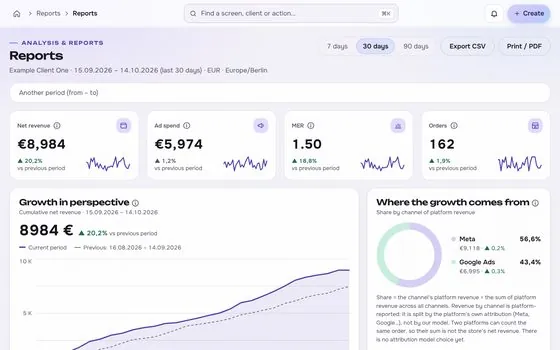


 LinkedInpost approvedexample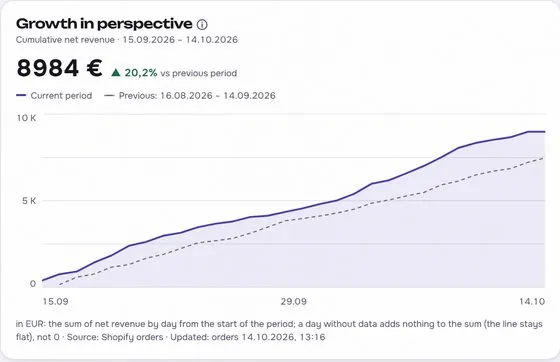


 WordPressdraft readyexample

 Slackclient repliedexample
 LinkedInpost approvedexampleWordPressdraft readyexampleSlackclient repliedexample
Stock photos and example labels, not customers.
In this section
Ad account spend cap
An ad account spend cap is a limit on the total amount an ad account may spend, set by the account owner or agreed with the client. It protects the budget when a campaign setting is wrong, because a runaway campaign still cannot go past the agreed amount.
Definition→Ad copy variant
An ad copy variant is one version of the written parts of an ad, such as the headline, the primary text, the description or the button label. Variants are written to test one difference at a time, so that a result can be traced to the change that caused it.
Definition→Ad frequency
Ad frequency is the average number of times one person saw your ad: impressions divided by reach.
Definition→Ad naming convention
An ad naming convention is a fixed pattern for campaign, ad set and ad names so a report can be sliced by parts of the name.
Definition→Ad set (ad group)
An ad set is the level between a campaign and its individual ads, and it holds the settings the ads share, such as audience, budget, schedule, placements and the optimisation goal. The name of this level differs by platform, so write down what your platform calls it.
Definition→AOV target (average order value target)
An AOV target is the average order value a store plans for, set so that a typical order covers its fixed costs and leaves room for acquisition. It turns a margin question into a basket size goal.
Definition→Approval queue
An approval queue is the list of items waiting for a named person to approve or reject them, such as a new ad, a budget change or a client report. Each item shows its owner, the date it was sent, its deadline and the decision once one is made.
Definition→Approval workflow
An approval workflow requires a named person to review and accept a change before it is applied, and records who approved what and when.
Definition→Asset version
An asset version is a saved state of a creative file, such as a video cut, an image or a copy document, with its own version number, date and a short note on what changed. It lets the team trace any live ad back to the exact file it used.
Definition→Attribution model
An attribution model is the rule that decides how credit for one order is shared among the touchpoints before it, such as an ad view, an ad click, an email or a search. Different models give different channel numbers from the same orders.
Definition→Attribution window
An attribution window is the time after a click or view during which a platform gives that ad credit for a purchase.
Definition→Audit trail
An audit trail is an append-only record of who proposed, approved and applied each change, what it was before and after, and when.
Definition→Average order value (AOV)
Average order value is revenue divided by the number of orders in a period.
Definition→Bid cap
A bid cap is the highest price an ad account is willing to pay for one result, such as a click, a lead or a purchase. It turns the profit target into a maximum cost, so that the account does not buy results that lose money.
Definition→Blended CAC
Blended CAC is total marketing spend divided by the number of new customers in the same period, across every channel.
Definition→Blended ROAS
Blended ROAS adds up the revenue that each ad platform claims and divides it by the total spend on those platforms. It is a sum of platform claims, not a store number, so it can overstate what the ads did.
Definition→Break-even ROAS
Break-even ROAS is the ROAS at which an order earns exactly its own ad cost back. It equals 1 divided by the contribution margin.
Definition→CAC payback period
CAC payback is the time it takes for a new customer's margin to cover what it cost to acquire them. Shorter payback means cash comes back sooner.
Definition→Change request
A change request is a written request to change something that was already agreed, such as the scope, the budget, a live ad, a deadline or a report format. It records the change, the reason, who approves it and what it does to time, cost and results.
Definition→Change window
A change window is a set period when planned edits to live ad accounts, budgets, tracking or landing pages are allowed. Outside it, changes wait for a named approver or for the next window, so every edit happens when someone is ready to check the result.
Definition→Churn rate (customer churn)
Churn rate is the share of customers at the start of a period who count as lost by the end of it, under a written rule for inactivity. For ecommerce the number depends heavily on how long a customer may go without ordering before they count as lost.
Definition→Click-through window
A click-through window is the number of days after an ad click during which a later purchase is credited to that ad. It is one part of an attribution window, and the view-through window is the other part.
Definition→Client dashboard
A client dashboard is a shared page that shows the agreed numbers for an agreed period, with each figure's source, definition and last refresh time. It is the view the client uses to check the work without asking for a new report every week.
Definition→Cohort
A cohort is a group of customers who share a starting point, such as their first order in the same month, and whose later orders are followed from that point. Cohorts separate how new buyers behave from the mix of old and new customers.
Definition→Cohort LTV (lifetime value by cohort)
Cohort LTV is the cumulative revenue or contribution per customer in one cohort, measured at fixed points after the first order, such as month 0, month 3 and month 12. It shows how the value of a group of new customers builds over time.
Definition→Contribution margin
Contribution margin is revenue minus the variable costs of an order (product cost, shipping, payment fees, returns), usually shown as a share of revenue.
Definition→Conversion rate
Conversion rate is the share of visits that ended in the action you count, usually a purchase. The definition of a visit and of the action must be written down.
Definition→Cookie consent
Cookie consent is the step where a website asks a visitor whether it may store or read cookies and similar identifiers, usually through a banner or a settings panel, and records the answer. This is a general concept for reporting, not legal advice.
Definition→CPA (cost per acquisition)
CPA is spend divided by the number of conversions an ad platform reports for that spend. What counts as a conversion depends on how the account is set up.
Definition→CPC (cost per click)
CPC is ad spend divided by clicks. It prices traffic, and it only matters in relation to how much of that traffic buys.
Definition→CPM (cost per thousand impressions)
CPM is the cost of showing an ad one thousand times. It says what reach costs, not whether the reach did anything useful.
Definition→Creative brief
A creative brief is a short written document that tells the people who make ads what to produce, for whom, and why. It covers the goal, the audience, the message, the formats, the must-have and must-not-have elements, and the deadline and approvers.
Definition→Creative fatigue
Creative fatigue is the decline in an ad's results after the same audience has seen it many times.
Definition→Creative ID
A creative ID is a stable identifier for one creative asset that appears in every ad name and tracking link that uses it.
Definition→Creative testing
Creative testing compares two or more ad creatives under similar conditions to find which one does better on a chosen metric before more budget goes behind it. A test is only useful when one variable changes and the success measure is written down before the test starts.
Definition→CTR (click through rate)
CTR is the share of impressions that ended in a click. It shows how well an ad earns attention, not how well it sells.
Definition→Customer lifetime value (LTV)
Customer lifetime value is an estimate of the total contribution a customer brings over their relationship with the store.
Definition→Customer retention
Customer retention is the share of a starting group of customers who are still buying from the store at the end of a set period. It measures whether the business keeps the buyers it already paid to win, which is the other half of the growth picture.
Definition→Data hygiene
Data hygiene is the routine work that keeps the data behind reports accurate and consistent, such as removing duplicates, fixing labels, using one currency and time zone, and recording known gaps. Clean inputs make the numbers comparable from one week to the next.
Definition→Dayparting
Dayparting limits or changes ad delivery by time of day or day of week. It helps only where results clearly differ by time.
Definition→First-party data
First-party data is information a business collects directly from its own customers and visitors, such as orders, account details and email sign-ups, with their consent. It is the data the business holds and can check against its own records.
Definition→Frequency cap
A frequency cap limits how often one person sees the same ad in a period. It protects against wear out and wasted reach.
Definition→Funnel (conversion funnel)
A funnel is the sequence of steps a visitor takes toward a purchase, with the count and the share that reaches each step. It shows where people leave, so the team can work on the step that loses the most people.
Definition→GA4 key event
A key event is an event in Google Analytics 4 that you mark as important to the business, such as a purchase. It replaced the term conversion in the interface.
Definition→Gross margin
Gross margin is revenue minus the cost of the goods sold, as a share of revenue. It is wider than contribution margin, which also removes shipping, fees and returns.
Definition→Guardrail
A guardrail is a limit or check that stops a change or a spend decision from going beyond an agreed range without a review. Examples include a daily budget cap, a floor on the return target, or a limit on how far one budget may move in a single step.
Definition→Handover note
A handover note is a short written record that passes an account, project or task to the next person. It covers what is running, what is waiting, what was promised, and where the records and access are, so the next person can act without rebuilding the history.
Definition→Hold-out audience
A hold-out audience is a group of people deliberately kept out of a campaign or an ad, so that their buying can be compared with the buying of people who were reached. The group is the tool, and the comparison it allows is the result, which shows what the ads added.
Definition→Holdout test
A holdout test withholds ads from a comparable group and compares its results with the group that saw them, to estimate the lift the ads caused.
Definition→Hook rate
Hook rate is the share of impressions that watch the first seconds of a video ad. It is most often defined as 3-second views divided by impressions.
Definition→Idempotency key
An idempotency key is a unique token sent with a write request so that retrying the request does not repeat the change.
Definition→Incrementality
Incrementality is the extra result caused by ads, compared with what would have happened without them. It is measured with a control, not read from a dashboard.
Definition→Learning phase
A learning phase is the period after an ad set starts or changes when a platform is still adjusting delivery. Results in it are less stable.
Definition→Lookalike audience
A lookalike audience is a group a platform builds to resemble a source list, such as past buyers. Its quality depends on the source and on the platform's model.
Definition→LTV to CAC ratio
LTV:CAC compares what a customer is expected to be worth over time with what it cost to acquire them. The result depends on how LTV is defined.
Definition→Marketing mix modeling (MMM)
Marketing mix modeling estimates how each channel contributed to sales from historical spend and sales data, without tracking individual users.
Definition→MCP (Model Context Protocol)
MCP is an open protocol that lets an AI assistant connect to tools and data. For agencies it is the way an assistant reads, and sometimes changes, an ad account.
Definition→MER (marketing efficiency ratio)
MER is total store revenue divided by total marketing spend over the same period. It ignores which ad platform claims the sale.
Definition→MER target
A MER target is the level of MER the business needs to reach its profit goal. It comes from the contribution margin and any other costs the ads must cover.
Definition→Naming QA (name check before launch)
Naming QA is a check that every campaign, ad set, ad and asset name follows the agreed naming convention before it goes live. It catches typos, missing fields and wrong codes early, so reports and tracking can match records without manual fixing.
Definition→Naming registry
A naming registry is a single shared list of every name used in an account, such as accounts, campaigns, ad sets, ads, creatives and UTM values, with who created each name and what it refers to. It lets anyone find a name and check that it is not already in use.
Definition→ncROAS (new customer ROAS)
ncROAS is the revenue from first-time customers divided by ad spend. It leaves out repeat buyers, who would often have bought anyway.
Definition→New customer rate
New customer rate is the share of orders in a period that came from customers who had not ordered before. It shows how much of the revenue depends on finding new buyers rather than selling to existing ones.
Definition→Payback window
A payback window is the number of days or months within which a customer's contribution must cover the cost of acquiring that customer. It sets how long the business is willing to wait for the money spent on a new customer to come back.
Definition→Platform ROAS
Platform ROAS is the revenue an ad platform attributes to its own ads divided by what you spent on that platform.
Definition→POAS (profit on ad spend)
POAS is the profit that ads produced divided by what they cost. It uses contribution margin instead of revenue, so it tells you whether the ads made money.
Definition→Read-back
Read-back means reading an object again from the ad platform after changing it, and comparing what is there with what you intended.
Definition→Repeat purchase rate
Repeat purchase rate is the share of customers who bought more than once in a period. It decides how much a first order is really worth.
Definition→Retargeting
Retargeting shows ads to people who already visited the store or interacted with the brand. It usually looks efficient because those people were closer to buying.
Definition→Return rate
Return rate is the share of orders, or of items, that customers send back. It cuts the real margin of what the ads sold.
Definition→ROAS (return on ad spend)
ROAS is the revenue attributed to ads divided by the ad spend that produced it. The attribution rule, window and platform change the result.
Definition→ROAS target
A ROAS target is the return on ad spend that the team aims for, set above break-even so that the spend also leaves a profit. It is a planning number, and it only means something when the margin and the profit goal behind it are written down.
Definition→ROI (return on investment)
ROI is the profit from an investment divided by its cost. Unlike ROAS, it is a profit measure, so it can be negative.
Definition→Rollback
A rollback returns an account setting, asset or tracking item to the state it had before a change, after that change causes a problem. A good rollback plan is written before the change, so the team knows which old values to restore and in what order.
Definition→Runbook
A runbook is a written, step-by-step procedure for a recurring or urgent task, such as a daily account check, a tracking fix or a launch. It is written so that a competent person can follow it without asking the author, which turns personal know-how into a repeatable process.
Definition→Server-side tracking
Server-side tracking sends conversion events from a server the business controls, instead of relying only on the visitor's browser. It can keep an event that the browser lost, but it does not add data that consent and other rules do not allow.
Definition→Service-level agreement (SLA)
A service-level agreement is a written commitment between an agency and its client about what will be delivered and how fast the agency responds, such as reply times, report dates and the scope of work. It sets expectations before the work starts, so both sides can see when a commitment has been missed.
Definition→Sign-off
Sign-off is a recorded approval from a named person that a plan, creative, report or change may go ahead. It shows who agreed, to which version, and when, so a later question about a decision can be answered from the record instead of from memory.
Definition→SKU margin
SKU margin is the contribution margin of one product variant. It shows which items the ads can afford to push and which they cannot.
Definition→Spend pacing
Spend pacing is how evenly a budget is used across a period, measured against the share of that period which has already passed. It shows whether spend is ahead of, on, or behind plan while there is still time to act before the period ends.
Definition→Test-and-learn roadmap
A test-and-learn roadmap is an ordered plan of tests for an account, where each test names the question it answers, the budget it needs, the owner, the decision rule and the date. Each result is meant to shape the next test, so the team learns in sequence instead of testing at random.
Definition→UGC ad (user-generated content ad)
A UGC ad is a paid ad built from content made by a real person, such as a customer or a hired creator, filmed in a casual, first-person style rather than in a studio. It is judged the same way as any other ad, by what it does to the numbers, not by how real it looks.
Definition→UTM parameters
UTM parameters are tags added to a link (source, medium, campaign, content, term) so analytics can tell where a visit came from.
Definition→View-through conversion
A view-through conversion is an order that a platform credits to an ad the customer saw but did not click, within the view window. It measures exposure, so it cannot prove that the ad caused the sale.
Definition→








 Built for shop owners, creators and agencies. Stock photos, not customers.
Run the next client review from one screen.
We open one agency at a time, with your own accounts connected read-only first.
Request access↗