
MER vs ROAS: which number an agency should report

Platform ROAS tells you how an ad platform scores itself. MER tells you how the business did. A client review needs both, clearly labelled.

What each number measures

Platform ROAS is the revenue a platform attributes to its own ads divided by what you spent there. MER is total store revenue divided by total marketing spend, with no attribution at all.

Why they disagree

Each platform counts orders using its own model and window, and platforms often claim the same order. Add three platform ROAS figures together and the claimed revenue can exceed what the store actually took.

  • Different attribution windows and view-through rules.
  • Orders claimed by more than one platform.
  • Orders no platform can see, such as direct or email traffic.

How to use them together

  • Use MER for the question 'is marketing paying for itself overall this month?'.
  • Use platform ROAS to rank ads and ad sets inside one platform.
  • Never add platform ROAS values to build a total.
  • Write the formula, period and currency next to every figure in the report.
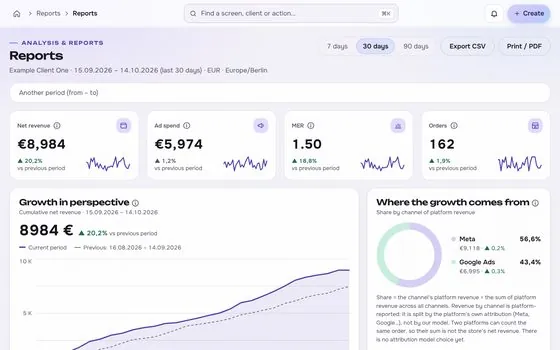
Example with made-up numbers: Meta reports 3.0 and Google reports 4.0, but total revenue divided by total spend is 2.4. The 2.4 is the figure to judge the month by; the other two help decide where to move budget.

What to put in the client report

Show MER as the headline, platform ROAS as supporting detail, and say plainly that platform figures overlap. If a number could not be measured, write 'not measured', never zero.
6 min read. Last updated 2026-10-07. Examples use made-up numbers.

This guide in numbers

6minutes to read
3terms explained
4sections
10related guides

Use it as a checklist

Tick items as you go. Your ticks stay in this browser only.

Keep reading

Measurement

How to calculate break-even ROAS for an ecommerce client

Break-even ROAS is the line between an ad that loses money and one that pays for itself. It takes three inputs and one division.

6 min read
Measurement

Why your MER is wrong: currencies, time zones and refunds

Most disagreements between a store and its ad reports are not strategy problems. They are mismatches in how two data sets were cut.

5 min read
Measurement

Blended CAC: what it is and when to use it

When platforms disagree about who deserves credit, blended CAC answers a plainer question: what did a new customer cost us in total?

5 min read
Measurement

Attribution windows explained for agency reports

Two reports on the same ads can show different results only because one used a seven day window and the other used a one day window.

6 min read
Measurement

Daily, weekly, monthly: what to look at when

Most bad ad decisions are reactions to a number that is only noise at that time scale. Match the number to the cadence.

7 min read
Measurement

A quality check before a client report goes out

A report with one wrong number costs more trust than ten right numbers earn.

5 min read
AI and automation

A safety checklist before an AI assistant touches ad accounts

An assistant that can read your accounts is a convenience. One that can write to them is a decision. This checklist separates the two.

6 min read
Measurement

Break-even MER vs break-even ROAS

Both numbers answer the same question, how much revenue each unit of spend must bring to avoid a loss, but at two different levels.

6 min read
Measurement

Subscription and one-time orders in MER: keep them apart

A subscription store can see its MER rise every month without acquiring anyone new. Splitting renewals from first orders keeps the number honest.

6 min read
Measurement

Why blended and platform ROAS disagree, and how to report the gap

Platform ROAS and blended ROAS answer different questions. A gap between them is normal, but an unexplained gap is not.

6 min read
Built for shop owners, creators and agencies. Stock photos, not customers.

Run the next client review from one screen.

We open one agency at a time, with your own accounts connected read-only first.

Request access

How we plan to price it